
Serengeti National Park
The Serengeti is the place that defines what people mean when they say 'African safari.' Its name — from the Maasai word Siringet, meaning the land that runs on forever — is one of the most evocative in travel. And it delivers on every part of that promise: vast, open, golden, teeming with life at a scale that modern experience has no reference point for.
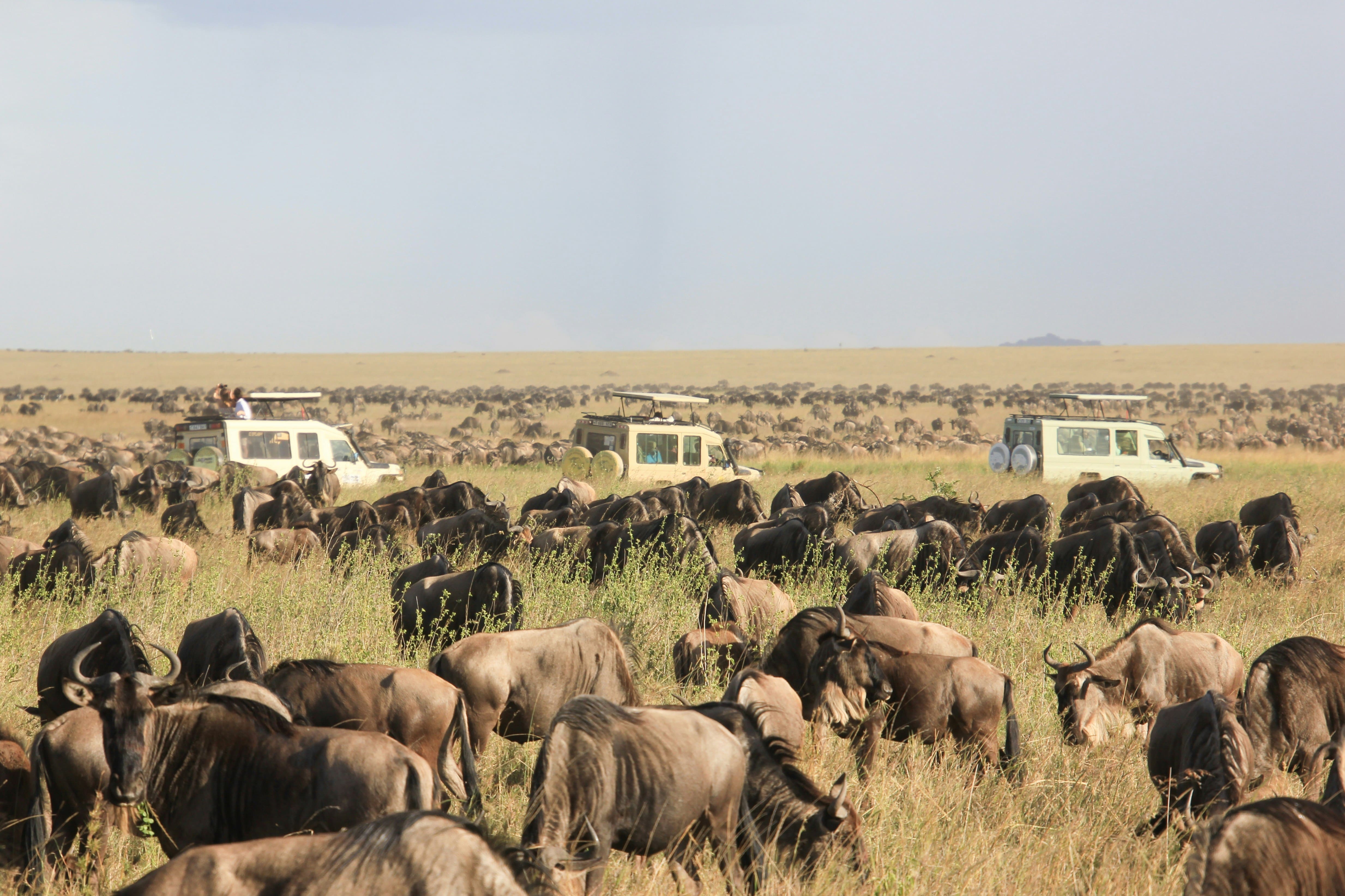
Tanzania's flagship national park covers 14,763 square kilometres of open grassland, riverine forest, acacia woodland, and ancient granite outcroppings. It forms the core of a broader ecosystem that extends north into Kenya's Masai Mara and shelters the single greatest concentration of large mammals on Earth. The Great Migration — 1.5 million wildebeest in continuous movement across the plains — happens here. The highest lion density in Africa lives here. The leopards of the Seronera River valley are among the most photographed and most habituated in the world.
This guide is built to give you everything you need to plan a Serengeti safari in 2026 — not just the highlights, but the specific zones, the precise seasonal timing, the activities that make a Serengeti trip extraordinary rather than just good, the lodges worth paying for, and the real costs at every level. It is written by the team at adventuresseeker.com, based in Arusha, Tanzania, who have driven the Serengeti's roads across every season.
SERENGETI NATIONAL PARK: QUICK FACTS
UNESCO Status
World Heritage Site (1981) and Biosphere Reserve
Size
14,763 km² — roughly the size of Northern Ireland or Connecticut
Established
1951 (game reserve from 1929)
Location
Northern Tanzania, Mara and Simiyu regions
Coordinates
2°19′S 34°50′E
Altitude
920 – 1,850 m above sea level
Ecosystem
Part of the Serengeti-Mara ecosystem (25,000 km² total with Kenya)
Annual Rainfall
500–1,200 mm/year (varies by zone)
Annual Temperature
15–35°C (cool nights in June–August down to 10°C)
Park Entry Fee
USD $70 per person per day (non-resident adult, 2026)
Getting There
7–8 hrs by road from Arusha; 1 hr by light aircraft
Nearest City
Arusha — the safari capital of Tanzania
Operator Reg.
Tanzania National Parks Authority (TANAPA)
Annual Visitors
~350,000–450,000 (varies; concentrated in peak season)
Famous For
Great Migration, Big Five, highest lion density in Africa, kopje leopards
Best Combined With
Ngorongoro Crater, Tarangire, Lake Manyara, Zanzibar
WHY THE SERENGETI IS AFRICA'S GREATEST SAFARI DESTINATION
Travellers choose safari destinations for different reasons — exclusivity, big cat density, elephant viewing, landscape photography. The Serengeti wins on nearly all of them simultaneously, which is why it consistently tops lists of the world's best wildlife experiences and why first-time visitors almost universally say they want to return.
Scale That Has No Equivalent
At 14,763 square kilometres, the Serengeti is ten times the size of Kenya's Masai Mara — the park most commonly compared to it. That scale means genuine wildness: even during peak season in August, you can drive for an hour in the central Serengeti without seeing another vehicle. In the southern Serengeti in February, you can be the only guests watching a cheetah stalk a wildebeest calf on an open plain stretching to the horizon. This is not a managed reserve — it is a functioning, undisturbed ecosystem at continental scale.
Wildlife Numbers That Redefine Density
- Blue Wildebeest
- Estimated population (Serengeti ecosystem): ~1.5 million
- Global significance: Part of the world's largest terrestrial migration
- Plains Zebra
- Estimated population (Serengeti ecosystem): ~300,000
- Global significance: Second most numerous large mammal in the ecosystem
- Thomson's Gazelle
- Estimated population (Serengeti ecosystem): ~500,000
- Global significance: Third most abundant large mammal in the Serengeti ecosystem
- Lion
- Estimated population (Serengeti ecosystem): ~3,000
- Global significance: Highest-density savannah lion population in Africa
- Leopard
- Estimated population (Serengeti ecosystem): ~1,000
- Global significance: One of Africa's best places to observe leopards
- Cheetah
- Estimated population (Serengeti ecosystem): ~1,000
- Global significance: Home to one of Africa's most extensively studied cheetah populations
- African Elephant
- Estimated population (Serengeti National Park): ~6,000
- Global significance: One of Tanzania's largest elephant populations
- African Buffalo
- Estimated population (Serengeti ecosystem): ~70,000
- Global significance: The primary prey base supporting Serengeti's lion population
- Spotted Hyena
- Estimated population (Serengeti ecosystem): ~7,000
- Global significance: Largest predator by biomass in the Serengeti ecosystem
- Hippopotamus
- Estimated population (Serengeti National Park): ~3,000
- Global significance: Large populations concentrated along permanent rivers and pools
- Nile Crocodile
- Estimated population: Very high density
- Global significance: Peak concentrations occur along the Mara River during the Great Migration (July–October)
- Masai Giraffe
- Estimated population (Serengeti ecosystem): ~10,000
- Global significance: One of the most abundant giraffe populations in East Africa
- Bird Species
- Recorded species: Over 500
- Global significance: Serengeti is recognized as one of Africa's premier birdwatching destinations
The Great Migration: A Natural Event Without Equal
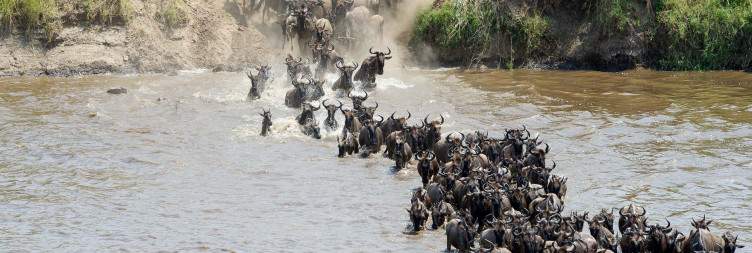
The Great Migration is the Serengeti's defining phenomenon — and the reason that more people visit Tanzania for a safari than any other country in Africa. 1.5 million wildebeest, 300,000 zebra, and 500,000 gazelle move in a continuous, year-round clockwise loop through the Serengeti-Mara ecosystem, following the rains and the fresh grass. The movement is not a single event — it is a cycle with multiple dramatic peaks: the calving season in February, the Grumeti River crossings in June, and the Mara River crossings in July and August that produce the most photographed wildlife moment on Earth.
Migration Scale: If all 1.5 million wildebeest in the Great Migration stood side by side, they would form a line stretching from Arusha to London. Their combined daily dung production is estimated at 450,000 tonnes per year — making them the most significant ecological force in the ecosystem.
Conservation Record
The Serengeti is one of the world's best-managed large protected areas. Tanzania's TANAPA (Tanzania National Parks Authority) operates 24-hour anti-poaching patrols, aerial surveillance, and ground ranger networks across the park. The park's lion population has grown significantly over the past decade, and the wildebeest population — which dipped to 250,000 in the 1960s following rinderpest — has recovered to 1.5 million under sustained protection. The Serengeti is genuinely a conservation success story, not merely a wildlife spectacle.
THE FOUR ZONES OF THE SERENGETI: WHERE TO GO AND WHEN
The Serengeti is not a single, uniform experience — it is a vast landscape with four geographically and ecologically distinct zones, each of which delivers a fundamentally different safari at a different time of year. Understanding the zones is the single most important factor in planning a Serengeti trip.
Zone 1: Southern Serengeti and Ndutu Plains
- Location
- South of the Seronera River, extending into the Ngorongoro Conservation Area
- Key Areas
- Ndutu
- Naabi Hill
- Gol Kopjes
- Lake Ndutu
- Lake Masek
- Peak Season
- January–March
- Key Event
- Great Migration calving season, with the peak occurring in February
- Landscape
- Vast short-grass plains, scattered acacia woodlands, and seasonal lakes
- Best For
- Witnessing the Great Migration calving season
- Cheetah sightings
- Newborn wildebeest and zebra
- High predator activity
- Wildlife photography
- Accommodation
- Seasonal mobile camps based around Ndutu, which relocate with the migration
- No permanent lodges on the open southern plains
- Crowd Level
- Surprisingly low considering the exceptional wildlife viewing opportunities
The southern Serengeti and the Ndutu Plains represent Tanzania's most underrated wildlife experience. From January through March, the Great Migration herds settle on the short-grass plains to graze on the nutrient-rich grass that sprouts after the November–December rains. The concentration of 1.5 million animals on a relatively compact area draws Africa's big cats in extraordinary density. This is where the calving season unfolds — roughly 400,000 to 500,000 wildebeest calves born in a compressed two-to-three-week pulse in February.
Within minutes of birth, each calf must stand and run. The concentration of vulnerable newborns produces predator action that is, in terms of frequency and intensity, unmatched anywhere in Africa in any other season. Cheetah kills, lion ambushes, leopard stalks, and hyena pack hunts can all be observed within a single morning drive in a small geographic area.
- Ndutu Lake: A seasonal soda lake that provides a water source for the migration herds and hosts flamingos, wading birds, and large crocodiles.
- Gol Kopjes: Ancient granite outcroppings rising from the southern plains — favoured lion and leopard resting sites with commanding views across the grassland.
- Photography: The green-season landscape (lush grass, blue skies, dramatic cloudscapes) combined with close-range predator action produces some of the finest wildlife photography in Africa.
📸 Photographer's Note: February in Ndutu offers the rarest combination in African wildlife photography: a lush green background, extraordinary predator action, and newborn animals at close range. Most professional wildlife photographers rate February in Ndutu above July–August at the Mara River for total photography value.
Zone 2: Central Serengeti — Seronera Valley
- Location
- South of the Seronera River, extending into the Ngorongoro Conservation Area
- Key Areas
- Ndutu
- Naabi Hill
- Gol Kopjes
- Lake Ndutu
- Lake Masek
- Peak Season
- January–March
- Key Event
- Great Migration calving season, with the peak occurring in February
- Landscape
- Vast short-grass plains, scattered acacia woodlands, and seasonal lakes
- Best For
- Witnessing the Great Migration calving season
- Cheetah sightings
- Newborn wildebeest and zebra
- High predator activity
- Wildlife photography
- Accommodation
- Seasonal mobile camps based around Ndutu, which relocate with the migration
- No permanent lodges on the open southern plains
- Crowd Level
- Surprisingly low considering the exceptional wildlife viewing opportunities
The Seronera Valley is the Serengeti's most consistently productive wildlife zone. The Seronera River is a permanent water source, and this single ecological fact anchors resident populations of lion, leopard, hippo, crocodile, and elephant regardless of what the migration is doing and regardless of the season. Even in April and May — the heart of the long rainy season — the Seronera area reliably produces outstanding game viewing.
The kopjes (pronounced 'copies') — ancient granite outcroppings that rise from the plain like scattered boulders — are the central Serengeti's most distinctive landscape feature and its most reliable leopard habitat. Specific trees on specific kopjes are known to experienced guides as regular resting sites for habituated leopards. Early morning drives to Simba Kopjes or Maasai Kopjes frequently produce large-spotted cats draped over fig branches at close range.
- Retima Hippo Pool: A permanent hippo pool in the Seronera River valley holding 50 or more hippos year-round. One of the Serengeti's most reliable and closest wildlife encounters — accessible within metres of a vehicle.
- Lion prides: The Seronera area's lion prides are among the most studied in the world, having been the subject of research since George Schaller's pioneering 1960s work. The prides are large, stable, and entirely habituated to safari vehicles.
- Resident birds: The Seronera valley has outstanding bird life year-round — lilac-breasted roller, secretary bird, kori bustard, grey-crowned crane, and numerous raptors.
🦁 First-Timer Tip: If this is your first Serengeti safari and you are limited to two or three nights, base yourself in the central Seronera area. It is the only zone guaranteed to produce excellent wildlife in any month — you will not need to gamble on migration timing.
Zone 3: Western Corridor and Grumeti River
- Location
- Western extension of Serengeti National Park toward Lake Victoria
- Key Areas
- Grumeti River
- Dutwa
- Kirawira
- Ndabaka Gate area
- Peak Season
- May–July
- Key Event
- Grumeti River crossings — the first major river challenge of the Great Migration
- Landscape
- Riverine forests
- Open grasslands
- Acacia woodlands
- Seasonal swamps
- Best For
- Watching the Great Migration cross the Grumeti River
- Seeing massive Nile crocodiles
- Exclusive safari experiences
- Fewer vehicles and excellent wildlife photography
- Accommodation
- Limited but exceptional options, including:
- Singita Grumeti (ultra-luxury private concession)
- Kirawira Serena Camp
- Limited but exceptional options, including:
- Crowd Level
- Very low, with vehicle numbers kept low through private concession management
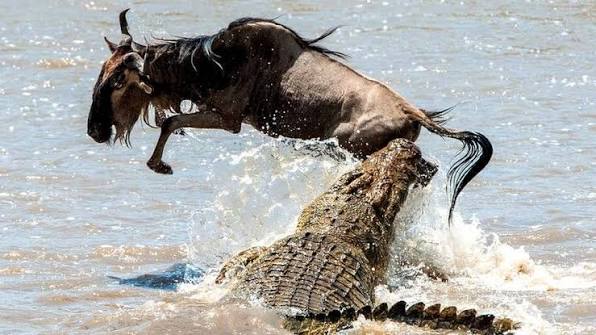
The Western Corridor is the least-visited zone of the Serengeti — and for travellers who can access it, one of the most rewarding. The corridor's defining feature is the Grumeti River: a narrow, fast-moving river whose thick riverine forest and deep pools shelter one of Africa's largest concentrations of Nile crocodiles, some of which grow to over five metres in length having fattened during years between migration crossings.
When the migration herds funnel westward in May and June, the Grumeti crossings produce some of the most dramatic wildlife scenes in Tanzania — often more chaotic and unpredictable than the Mara crossings because the river is narrower, faster, and the crocodile density is higher relative to the crossing points. The Western Corridor also hosts Singita Grumeti's 350,000-acre private concession — one of Africa's finest and most exclusive safari properties — where visitor numbers are tightly controlled and wildlife encounters feel genuinely private.
- Grumeti Reserves: Singita's private concession adjacent to the Grumeti River is managed under an exclusive arrangement with TANAPA. Game drives here operate with no other vehicles — a dramatically different experience from public areas.
- Night drives: Permitted within the private Grumeti concession. Nocturnal encounters — leopard on the hunt, aardvark, genet, honey badger — are unique to this western zone.
Zone 4: Northern Serengeti — Kogatende and Lamai Wedge
- Location
- Far northern Serengeti, bordering Kenya's Masai Mara
- Key Areas
- Kogatende
- Lamai Wedge
- Mara River
- Bolonganja River
- Peak Season
- July–October
- Key Event
- Mara River crossings — the most dramatic and iconic stage of the Great Migration
- Landscape
- Rolling open plains
- Riverine acacia woodland
- Steep, scenic banks along the Mara River
- Best For
- Witnessing Mara River crossings
- Viewing large Nile crocodiles
- Lion sightings
- Wildlife photography
- Accommodation
- Specialist migration camps that follow the seasonal wildlife movements
- Many lodges and camps are fully booked 10–14 months in advance during peak migration season
- Crowd Level
- High around Mara River crossing points in July and August
- Moderate in other parts of the northern Serengeti
The northern Serengeti is where the Great Migration reaches its most extraordinary and most photographed climax. The Mara River — wide, fast, murky, and home to enormous Nile crocodiles — forms the boundary between Tanzania and Kenya, and crossing it is the wildebeest's most dangerous recurring challenge. Between July and October, herds of thousands mass on the steep south bank, milling with nervous energy for hours before one wildebeest takes the leap that triggers a stampede of thousands.
The crossing itself is one of those wildlife experiences that no description adequately prepares you for. The scale — thousands of animals in the water simultaneously — and the sound — a roar of hooves, water, and vocalisation — and the violence of the crocodile attacks are all simultaneously overwhelming. Crossings range from 20 minutes to three hours. No two are the same. Photographers who wait at established crossing points for full days can witness three or four crossings in sequence.
- Lamai Wedge: A triangular area of land between the Mara River and the Bolonganja River that can trap migration herds — producing crossing activity from multiple directions. Some guides consider Lamai the single finest crossing-watching location in the ecosystem.
- Kogatende: The most popular crossing area, with established banks that the herds return to repeatedly. Several camps within walking distance of prime crossing points.
- Resident wildlife: Even without migration crossings, the northern Serengeti has outstanding resident wildlife — large lion prides, topi herds, eland, and consistent elephant movement.
📅 Booking Alert: Northern Serengeti migration camps at Kogatende and Lamai sell out for July and August in October or November of the previous year — sometimes earlier. If seeing the Mara crossings is your primary goal, contact adventuresseeker.com in the autumn for the following summer season.
THE GREAT MIGRATION: COMPLETE MONTH-BY-MONTH GUIDE
The Great Migration is the reason most people plan a Serengeti safari — but it is widely misunderstood as a single event rather than the continuous, year-round cycle it actually is. Here is exactly where the herds are, month by month, and what you can expect to see.
- January
- Migration location: Southern Serengeti / Ndutu Plains
- Key event: Herds graze the short-grass plains as calving season approaches
- Visitor experience: Increasing predator activity, lush green landscapes, and excellent cheetah sightings
- February
- Migration location: Ndutu Plains (peak season)
- Key event: Calving season — approximately 400,000–500,000 wildebeest calves are born
- Visitor experience: The year's most intense predator action and exceptional wildlife photography opportunities
- March
- Migration location: Southern to Central Serengeti
- Key event: Herds begin moving north as the long rains start
- Visitor experience: A transition month with excellent predator sightings and increasingly green scenery
- April
- Migration location: Central Serengeti
- Key event: Herds continue dispersing north through the central region
- Visitor experience: Low visitor numbers, excellent game viewing around Seronera, though some roads may become muddy
- May
- Migration location: Central Serengeti to the Western Corridor
- Key event: Herds reach the Western Corridor
- Visitor experience: Lower accommodation prices, peak birdwatching season, and fewer crowds
- June
- Migration location: Western Corridor / Grumeti River
- Key event: Grumeti River crossings begin
- Visitor experience: First dramatic river crossings, large Nile crocodiles, and the beginning of the dry season
- July
- Migration location: Northern Serengeti / Mara River
- Key event: Mara River crossings begin and peak season starts
- Visitor experience: Spectacular migration drama with frequent river crossings and excellent predator sightings
- August
- Migration location: Northern Serengeti
- Key event: Peak Mara River crossings with the largest and most frequent crossings
- Visitor experience: The most spectacular migration viewing, highest visitor numbers, and peak travel prices
- September
- Migration location: Northern Serengeti and into Kenya's Masai Mara
- Key event: River crossings continue as some herds move into Kenya
- Visitor experience: Continued migration action with slightly fewer crowds than August
- October
- Migration location: Northern Serengeti
- Key event: Herds begin their return journey south
- Visitor experience: River crossings may still occur, while resident wildlife viewing remains excellent
- November
- Migration location: Central and Northern Serengeti
- Key event: Herds spread southward with the arrival of the short rains
- Visitor experience: Fresh green landscapes and many other species giving birth
- December
- Migration location: Southern Serengeti
- Key event: Herds return to the southern plains ahead of the calving season
- Visitor experience: Excellent wildlife viewing, greener landscapes, and increasing predator activity before calving begins
River Crossings: What to Expect
The Mara River crossings are the most sought-after wildlife spectacle in Africa. Here is the reality of experiencing them:
- Timing is unpredictable: The herds can mass on the bank for six hours and then retreat without crossing. They can also cross with no warning. There is no schedule. The best strategy is to position yourself at a known crossing bank early in the morning and wait.
- Patience is rewarded: Guides with deep experience of specific crossing points — knowing which banks the herds return to, which areas the crocodiles favour, and which direction the herd approaches from — consistently produce better crossings than guides who chase the herd reactively.
- Multiple crossings: In peak season (July–August), it is possible to witness three or four crossings in a single day from a fixed position. The herds cross and re-cross the same points repeatedly.
- Crowd management: Popular crossing banks can attract 20 to 40 vehicles at peak. Book a private vehicle so you can position exactly where your guide recommends without pressure from other passengers.
- Grumeti vs Mara: The Grumeti River crossings (June, Western Corridor) are less famous but often produce more intense individual crossings because the river is narrower and crocodile density is higher per unit of crossing width. Some photographers prefer Grumeti for its rawness.
Adventures Seeker Migration Strategy: We plan every migration itinerary around specific zone timing rather than calendar month. Tell us your exact travel dates and we will position you in the zone producing the best migration activity for those specific days — not just the zone that is popular in your general season.
SERENGETI WILDLIFE: COMPLETE SPECIES GUIDE
The Big Five in the Serengeti
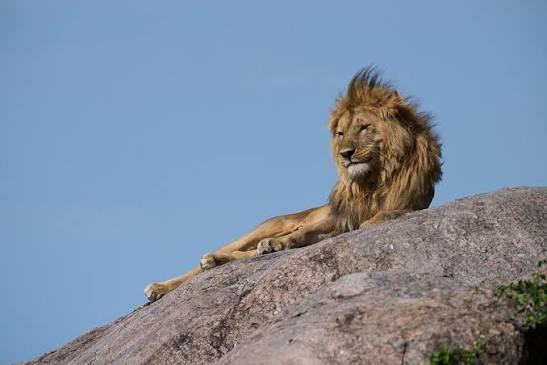
Lion (Panthera leo) — Easiest Big Five Sighting in Africa
The Serengeti holds approximately 3,000 lions — the highest density lion population in Africa. Prides here are large, stable, and entirely habituated to safari vehicles. A typical Seronera pride can number 20 or more adults and sub-adults. Lions are seen on virtually every game drive in the central Serengeti; in peak months at prime locations, multiple prides are encountered in a single morning. The Serengeti's lions are notably bold — they hunt in daylight, rest in open grass, and approach vehicles with complete indifference.
- Best zone: Central Seronera year-round; Northern Serengeti July–October when migration prey is abundant.
- Best time of day: Dawn drives (5:30–8:00 AM) catch prides returning from night hunts, often near or on a kill.
- Mane quality: The Serengeti produces some of Africa's darkest, fullest manes — a sign of high testosterone and robust health. The Ngorongoro Crater lions are even more pronounced.
Leopard (Panthera pardus) — Most Reliably Viewable in Africa
The Serengeti's kopje landscape produces the most reliable and closest-range leopard encounters available anywhere in Africa. The central Seronera valley's habituated population has learned over decades that safari vehicles pose no threat, allowing extended observation that would be impossible with less-habituated cats. Guides with Seronera expertise know specific trees on specific kopjes where individual leopards regularly rest — providing what can feel like a guaranteed sighting when the guide knows where to look.
- Best zone: Central Seronera — Simba Kopjes, Maasai Kopjes, Seronera River acacia
- Best behaviour to observe: A leopard caching a kill in a tree (requires enormous strength — a 60 kg impala lifted 6 metres), or a mother carrying prey to cubs in a kopje den
- Night leopard: Available only in private concessions. The Western Corridor's private Grumeti Reserve runs night drives where leopard encounters are significantly more frequent.
African Elephant (Loxodonta africana)
Approximately 6,000 elephants live within the Serengeti National Park, with much larger numbers across the broader ecosystem. Elephants are present year-round throughout the park — encountered individually or in family groups in riverine areas, woodland edges, and crossing roads without interruption to their daily circuits. The Serengeti's bulls are particularly impressive: large, old individuals with substantial ivory who have learned to navigate the human presence of the safari industry with complete equanimity.
- Best viewing: Central Serengeti woodland areas, Western Corridor, and any permanent river year-round.
- For peak elephant numbers: Tarangire National Park (added to a combined itinerary) produces larger concentrations — 200 to 300 animals at a single waterhole in the dry season.
Cape Buffalo (Syncerus caffer)
Buffalo are abundant throughout the Serengeti in herds that can exceed 1,000 animals. Large bachelor herds of old bulls — scarred, mud-caked, and deeply suspicious — provide some of the park's most intense close-range encounters. In the dry season, buffalo compete with other species at permanent waterholes, producing extraordinary wildlife density scenes. Lions hunt buffalo as their primary large prey, and lion-buffalo confrontations — sometimes involving herds defending individuals against attacking prides — are among the Serengeti's most dramatic wildlife encounters.
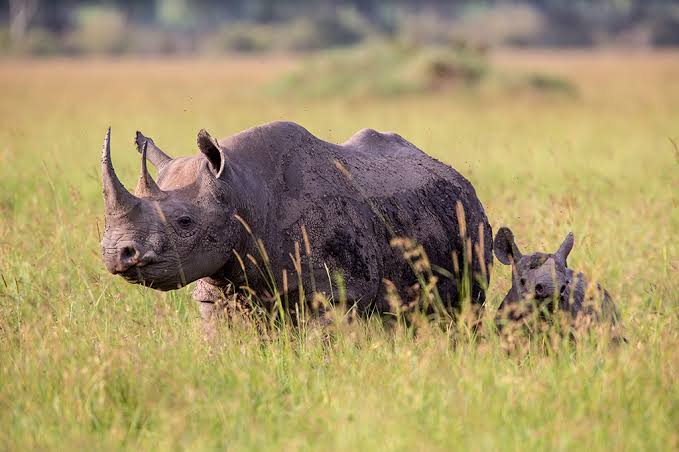
Black Rhinoceros (Diceros bicornis) — Rarely Seen in the Serengeti
Tanzania's black rhino population was decimated by poaching in the 1970s and 1980s, and the Serengeti's remnant population is very small and rarely encountered. For reliable black rhino sightings, the Ngorongoro Crater (approximately 26 individuals, regularly viewable) is the appropriate destination. Do not plan a Serengeti safari with rhino as a primary objective — it is a bonus if encountered, not an expectation.
Predators and Specialist Wildlife
Cheetah (Acinonyx jubatus)
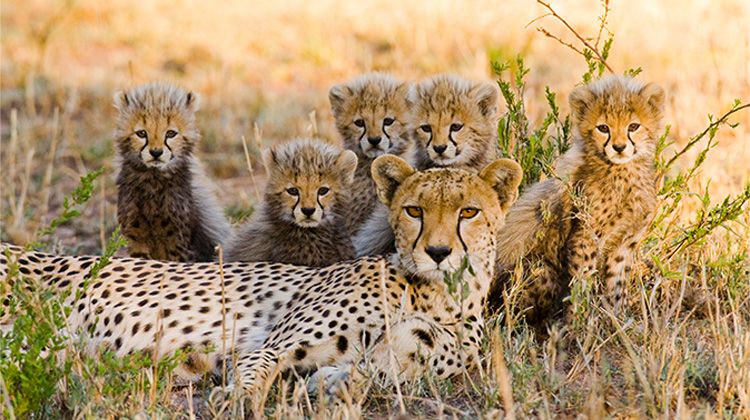
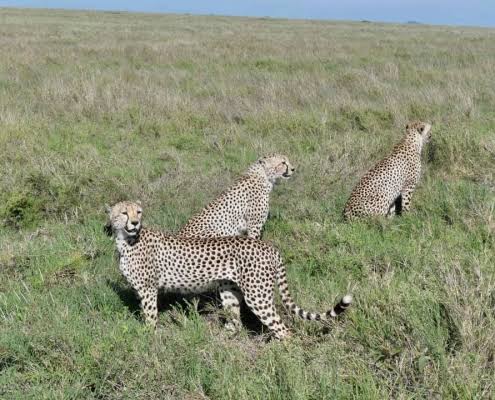
The Serengeti ecosystem holds approximately 1,000 cheetahs — one of Africa's most studied and most reliably viewable populations. The open short-grass plains of the central and southern Serengeti are ideal cheetah habitat: flat, open ground where the cheetah's speed advantage can be fully used. Cheetahs hunt in daylight (unlike most big cats), making them straightforward to observe. The best sightings occur when a cheetah is actively hunting — the characteristic crouching stalk, the explosive acceleration, and the takedown can unfold within metres of a stationary vehicle.
- Best zone: Southern Serengeti and Ndutu (January–March) for peak cheetah density during calving. Central Serengeti year-round for resident individuals and coalitions.
- Coalitions: Male cheetahs often form coalitions of two to five brothers — these groups are more confident hunters, capable of taking larger prey and holding kills longer against competition. Cheetah coalitions in the Serengeti are a specific and photogenic sighting.
African Wild Dog (Lycaon pictus)
African wild dogs are the rarest of the Serengeti's major predators — and arguably the most exciting to encounter. Their complex pack hierarchy, cooperative hunting behaviour, and extraordinary stamina (capable of maintaining 60 km/h for several kilometres) make them one of safari's most electrifying sightings. Sightings in the Serengeti are unpredictable — packs range widely across the ecosystem and their territory overlaps significantly with lions, which actively persecute them. Guides track known packs by radio contact and word-of-mouth between operators.
- Sighting probability: Low but not rare — perhaps 30–40% chance on a 7-day Serengeti safari with an experienced guide.
- For reliable wild dog sightings: Ruaha and Nyerere in the Southern Circuit offer significantly higher sighting rates and are worth adding to an itinerary for wild dog enthusiasts.
Spotted Hyena (Crocuta crocuta)
The spotted hyena is the Serengeti's most numerous large predator by biomass — approximately 7,000 individuals in the ecosystem. The popular image of the hyena as a passive scavenger is entirely inaccurate: hyenas are efficient hunters in their own right, capable of running down wildebeest and zebra and often stealing kills from lions. Hyena clan structure is extraordinarily complex and female-dominated — the alpha female is the most powerful individual in the group. Watching a hyena clan at a kill, or following a night hunt (in private concessions), is one of the Serengeti's underrated wildlife encounters.
Serval Cat (Leptailurus serval)
The serval is one of Africa's most beautiful and least-seen small cats — a tall, long-legged specialist of tall grass who hunts by sound, leaping vertically to pounce on rodents and birds. The Serengeti's grasslands provide ideal serval habitat, and in the early morning when the grass is wet and the cats are active, sightings are possible for attentive guides. Servals are nocturnal but regularly encountered at dawn and dusk.
Birds of the Serengeti
Over 500 bird species have been recorded in the Serengeti National Park, making it one of Africa's premier birding destinations. The park's diversity of habitats — open grassland, riverine acacia, kopje scrub, seasonal wetlands — supports an extraordinary range of species.
- Kori Bustard (Ardeotis kori)
- Best habitat: Open grasslands
- Best months: Year-round
- Notes: The world's heaviest flying bird, often seen walking across the plains
- Secretary Bird (Sagittarius serpentarius)
- Best habitat: Open grasslands
- Best months: Year-round
- Notes: A distinctive bird that stalks the plains while hunting snakes and rodents
- Lilac-Breasted Roller (Coracias caudatus)
- Best habitat: Acacia woodlands and rocky kopjes
- Best months: Year-round
- Notes: Famous for its brilliant colors and considered one of Tanzania's most photogenic birds
- Martial Eagle (Polemaetus bellicosus)
- Best habitat: Open woodlands
- Best months: Year-round
- Notes: Africa's largest eagle, known for hunting monitor lizards, birds, and small mammals
- Grey-Crowned Crane (Balearica regulorum)
- Best habitat: Wetlands and grasslands
- Best months: Year-round
- Notes: Elegant cranes often seen in pairs or small groups near water
- Southern Ground Hornbill (Bucorvus leadbeateri)
- Best habitat: Open grasslands
- Best months: Year-round
- Notes: Large ground-dwelling hornbills that roam the plains in family groups
- Lappet-Faced Vulture (Torgos tracheliotos)
- Best habitat: Any habitat near carcasses
- Best months: Year-round
- Notes: Africa's largest vulture and usually the dominant scavenger at kills
- Saddle-Billed Stork (Ephippiorhynchus senegalensis)
- Best habitat: Wetlands and rivers
- Best months: Year-round
- Notes: Africa's tallest stork, easily recognized by its striking multicolored bill
- Black-Bellied Bustard (Lissotis melanogaster)
- Best habitat: Short-grass plains
- Best months: Year-round
- Notes: Known for spectacular display flights and calling from termite mounds
- Migratory Raptors
- Best habitat: All habitats
- Best months: November–April
- Notes: Thousands of migratory birds of prey, including Steppe Eagles, Montagu's Harriers, and Lesser Kestrels, arrive during the northern winter
BEST TIME TO VISIT THE SERENGETI: MONTH-BY-MONTH
There is no universally 'bad' time to visit the Serengeti — the park's year-round resident wildlife guarantees a productive safari in any month. But the experience changes dramatically by season and by zone. Here is the complete month-by-month breakdown.
- January
- Zone: Southern Serengeti / Ndutu
- Wildlife Highlight: Predator build-up before calving season
- Weather: Hot with brief showers
- Crowds: Moderate
- Rating: ⭐⭐⭐⭐
- February
- Zone: Ndutu Plains
- Wildlife Highlight: Calving season — peak predator action
- Weather: Warm and mostly dry
- Crowds: Moderate
- Rating: ⭐⭐⭐⭐⭐
- March
- Zone: Central / Southern Serengeti
- Wildlife Highlight: Calving season ending; herds begin moving north
- Weather: Rains beginning
- Crowds: Low
- Rating: ⭐⭐⭐
- April
- Zone: Central Seronera
- Wildlife Highlight: Excellent resident wildlife; herds dispersing
- Weather: Peak of the long rains
- Crowds: Very Low
- Rating: ⭐⭐⭐
- May
- Zone: Central / Western Serengeti
- Wildlife Highlight: Late rains; herds approaching the Western Corridor
- Weather: Late rains
- Crowds: Very Low
- Rating: ⭐⭐⭐
- June
- Zone: Western Corridor
- Wildlife Highlight: Grumeti River crossings begin; dry season opens
- Weather: Dry and pleasant
- Crowds: Low
- Rating: ⭐⭐⭐⭐
- July
- Zone: Northern Serengeti
- Wildlife Highlight: Mara River crossings begin — peak migration season starts
- Weather: Dry and warm
- Crowds: High
- Rating: ⭐⭐⭐⭐⭐
- August
- Zone: Northern Serengeti
- Wildlife Highlight: Peak Mara River crossings — most frequent crossings
- Weather: Dry and warm
- Crowds: Highest
- Rating: ⭐⭐⭐⭐⭐
- September
- Zone: Northern Serengeti
- Wildlife Highlight: River crossings continue; some herds move into Kenya
- Weather: Dry and warm
- Crowds: High
- Rating: ⭐⭐⭐⭐⭐
- October
- Zone: Northern Serengeti → Southern Serengeti
- Wildlife Highlight: Return migration crossings; resident wildlife viewing peaks
- Weather: Transitioning season
- Crowds: Moderate
- Rating: ⭐⭐⭐⭐
- November
- Zone: Central / Northern Serengeti
- Wildlife Highlight: Short rains, newborn animals, and excellent bird activity
- Weather: Brief showers
- Crowds: Low
- Rating: ⭐⭐⭐
- December
- Zone: Southern Serengeti
- Wildlife Highlight: Herds return to southern plains; landscape improves before calving
- Weather: Partly dry
- Crowds: Moderate
- Rating: ⭐⭐⭐⭐
The Two Best Windows in Detail
Best Overall (July–October — Dry Season): The east African dry season produces the combination of sparse vegetation (easy spotting), animals concentrated at water sources (predictable sightings), excellent photography light (clear skies, golden hour), and the Mara River crossings (July–September). This is the most popular window and deservedly so.
Best Value (January–February — Calving Season): The calving season in the southern Serengeti/Ndutu is the best-kept secret in Tanzania tourism. The wildlife intensity — extraordinary predator action around 500,000 newborn calves — rivals or exceeds what you see at the Mara crossings. Lodge prices are 20–35% lower than peak. Visitor numbers are significantly lower. The lush green landscape produces better photography backgrounds than the dry season's dust. This is the window we most frequently recommend to returning visitors and discerning first-timers.
SAFARI EXPERIENCES IN THE SERENGETI
The Serengeti offers a range of wildlife experiences beyond the standard game drive — each of which adds a completely different dimension to the safari.
1. Game Drives (The Foundation)
Game drives in the Serengeti operate in open-sided or pop-top 4WD Land Cruisers or Land Rovers — purpose-built for wildlife observation with 360-degree visibility and raised seating positions. Drives typically run from 6:00–11:00 AM (the most productive hours when predators are active and light is best) and again from 3:00–6:30 PM (for late afternoon light and lion activity).
- Private vs shared vehicle: A private vehicle is strongly recommended for the Serengeti. You control when to stop, how long to stay at a sighting, and where to position. Shared vehicles compromise all three. The cost difference is typically $150–$300 per day — worth every dollar for a destination of this calibre.
- Pop-top vehicles: Request a vehicle with a pop-top roof hatch rather than a solid roof. This allows you to stand and photograph with an unobstructed 360-degree view — impossible from a fixed-roof vehicle.
- Night drives: Prohibited within the national park. Available in private concessions adjacent to the park — book through operators holding specific concession permits.
🚙 Vehicle Tip: The best safari vehicle in the Serengeti is a clean, well-maintained pop-top Toyota Land Cruiser 4WD with a knowledgeable guide who knows the specific territories of the resident predator prides and individuals. Ask your operator about their vehicle condition and guide experience before booking.
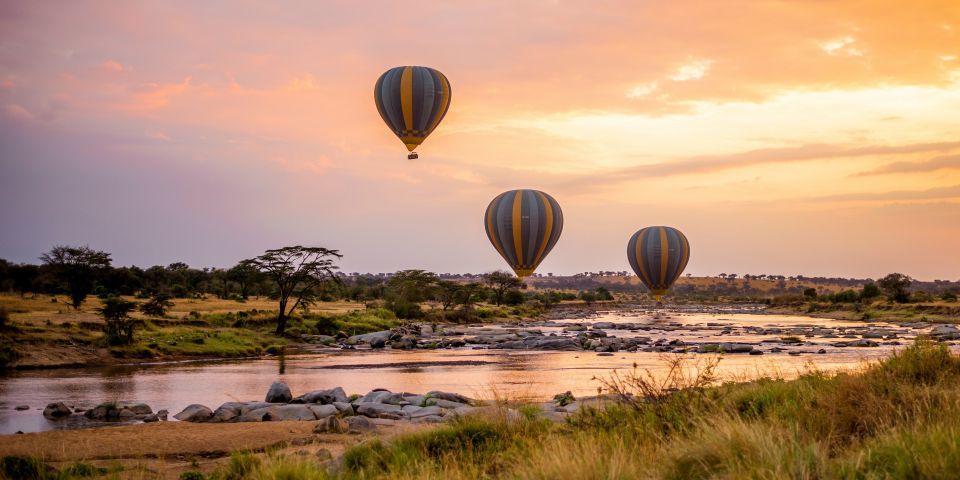
2. Hot Air Balloon Safari
A dawn hot air balloon flight over the central Serengeti is one of Tanzania's most celebrated experiences. The balloon inflates at 5:30 AM and lifts off as the sky begins to lighten. For approximately one hour, you drift silently at heights ranging from treetop level to several hundred metres above the plain. The perspective is unlike any other wildlife encounter: a bird's-eye view of the ecosystem in motion — elephant herds moving to water, a lion pride finishing a hunt, zebra and wildebeest dispersed across the grass below.
The flight concludes with a full champagne breakfast served on white linen in the open bush, prepared by the flight crew and accompanied by a brief certificate ceremony. The whole experience from wake-up to breakfast return is approximately 4 hours.
- Cost: Approximately $600–$700 per person (2026). Not included in standard lodge rates — booked additionally.
- Availability: Year-round from central Seronera area. Book in advance — flights fill up in peak season.
- Weather dependency: Flights may be cancelled in heavy rain or strong winds. Operators rebook at no charge but cannot guarantee weather.
- Weight limit: Baskets have weight limits per compartment — advise your operator of total group weight when booking.
3. Walking Safari (Concession Areas)
Walking safaris are prohibited within the national park boundaries but are available in private concessions and conservancy areas adjacent to the Serengeti. Licensed, armed rangers lead guided walks of 2 to 4 hours through the bush — an entirely different experience from a vehicle-based drive. On foot, the scale of the environment changes: a termite mound becomes a navigational landmark, a pile of dung tells you that a buffalo passed 40 minutes ago, and the sound of a breaking branch 100 metres away commands complete attention.
Walking in lion and elephant country requires trust in your guide and ranger, an absence of panic, and a willingness to move slowly and quietly. For guests who can manage this, a guided walk in the Serengeti ecosystem is the single most viscerally powerful wildlife experience available.
4. Night Drives (Private Concessions Only)
The Serengeti after dark is a completely different ecosystem. The predators that rested through the midday heat emerge. Leopards move through the acacia, hunting in silence. Aardvark emerge from burrows to excavate termite mounds. Porcupines rattle across the road. African civets, servals, white-tailed mongooses, and spring hares appear in the spotlight. Lions are active, often moving long distances between territories.
Night drives are run in open vehicles with handheld spotlights. The technique is to scan the grass and trees for eye-shine — the reflected light from nocturnal animals' tapetum lucidum (the reflective layer behind the retina). An experienced guide reads eye-shine by colour: the amber of a lion, the green of a genet, the orange of a bush baby.
5. Fly-in Safari (Seronera and Remote Airstrips)
The Serengeti has multiple operational airstrips — Seronera (central), Kogatende (north), Grumeti (west), Ndutu (south) — served by scheduled light aircraft services from Arusha, Kilimanjaro, and Zanzibar. Flying into the Serengeti rather than driving saves 7 to 8 hours of road time and provides an extraordinary aerial perspective: the vast scale of the ecosystem, migration herds visible from altitude, and the dramatic topography of the Ngorongoro highlands.
- Seronera: Primary airstrip. Year-round scheduled services from Arusha (45 min) and Zanzibar (~55 min).
- Kogatende: Northern Serengeti airstrip. Essential for migration crossing visitors — getting there by road is a full day from Arusha.
- Inter-Serengeti flights: It is possible to fly between zones within the Serengeti — e.g., fly from Ndutu to Kogatende — dramatically reducing transit time between southern calving and northern crossings on a combined itinerary.
6. Cultural Visits — Maasai Communities
The Maasai people have coexisted with the Serengeti ecosystem for centuries, herding cattle across landscapes that also support lion, buffalo, and elephant under an ancient understanding of shared territory. Several operators offer visits to authentic Maasai boma (homesteads) near the park boundary — arranged with community consent and direct financial benefit flowing to the village, not through third-party intermediaries.
A genuine Maasai cultural visit — not the commercialised version at the park gate — provides context that transforms every subsequent game drive. Understanding the Maasai philosophy of coexistence, their ecological knowledge, and their relationship to the land adds an intellectual and human dimension that pure wildlife observation cannot supply.
WHERE TO STAY IN THE SERENGETI: LODGE AND CAMP GUIDE
The Serengeti offers accommodation across every tier from basic public camping to some of the world's most expensive and exclusive safari lodges. The right choice depends on budget, travel style, which zone your itinerary prioritises, and the importance you place on lodge quality versus maximum time in the field.
Understanding the Serengeti's Accommodation Model
Permanent lodges and camps: Fixed structures in specific locations, operating year-round. The central Seronera area has the widest choice. Northern and western camps are more limited.
Mobile or seasonal camps: Lightweight tented camps that move seasonally to follow the migration. These typically offer the closest proximity to the wildlife events (calving at Ndutu, crossings in the north) but have limited facilities compared to permanent properties.
Private concession camps: Located in concession areas outside the park with exclusive game drive rights. Available only through specific operators. Prices are higher but the exclusivity — and the night-drive and walking safari permissions — are significant advantages.
Public campsite camping: Basic public campsites with minimal facilities inside the park. Used by budget operators. The wildlife is identical — what changes is the camp environment at night.
- Serengeti Sopa Lodge
- Zone: Central Serengeti
- Tier: Comfort
- Highlights: Reliable accommodation, large rooms, infinity pool, and excellent location
- Approx. cost/night per person: $180–$350
- Serengeti Serena Safari Lodge
- Zone: Central Serengeti
- Tier: Comfort
- Highlights: Hilltop location with panoramic plains views and consistent food quality
- Approx. cost/night per person: $220–$400
- Mbuzi Mawe Tented Camp (&Beyond)
- Zone: Central Serengeti
- Tier: Premium
- Highlights: Unique kopje setting, intimate atmosphere, and excellent guiding team
- Approx. cost/night per person: $500–$900
- Lemala Nanyukie
- Zone: Central Serengeti
- Tier: Premium
- Highlights: Small luxury tented camp with superb cuisine and a strong guide team
- Approx. cost/night per person: $450–$800
- Four Seasons Safari Lodge Serengeti
- Zone: Central Serengeti
- Tier: Luxury
- Highlights: Infinity pool overlooking the plains, spa, family suites, and fine dining
- Approx. cost/night per person: $800–$1,500
- Singita Grumeti Sabora Camp
- Zone: Western Serengeti
- Tier: Ultra-Luxury
- Highlights: Private 350,000-acre concession, butler service, and air charter access
- Approx. cost/night per person: $2,000–$4,500
- Singita Grumeti Faru Faru Lodge
- Zone: Western Serengeti
- Tier: Ultra-Luxury
- Highlights: Riverside setting, private pool villas, and exclusive concession access
- Approx. cost/night per person: $2,000–$4,500
- Nomad Lamai Serengeti
- Zone: Northern Serengeti
- Tier: Luxury
- Highlights: Prime Mara River crossing location, only 8 tents, and migration-focused experience
- Approx. cost/night per person: $900–$1,800
- Ubuntu Camp (Asilia Africa)
- Zone: Northern Serengeti
- Tier: Premium
- Highlights: Small mobile camp positioned near crossing areas with excellent guiding
- Approx. cost/night per person: $700–$1,200
- Ndutu Safari Lodge
- Zone: Southern Serengeti
- Tier: Comfort
- Highlights: Classic calving-season base with authentic atmosphere and experienced guides
- Approx. cost/night per person: $200–$400
- Lemala Ndutu Camp
- Zone: Southern Serengeti
- Tier: Premium
- Highlights: Mobile camp located on the calving plains with expert migration and calving guides
- Approx. cost/night per person: $500–$900
- Olakira Migration Camp (Asilia Africa)
- Zone: Multi-zone Serengeti
- Tier: Premium
- Highlights: Follows the Great Migration by moving between southern and northern Serengeti locations
- Approx. cost/night per person: $600–$1,000
How to Choose
- For first-time visitors: Central Seronera area. Year-round reliability, widest accommodation choice, easy logistics. Serengeti Serena or Lemala Nanyukie are strong mid-to-premium picks.
- For migration crossings (July–August): Northern Serengeti — Lamai or Kogatende area camps. Book 10–14 months ahead. Nomad Lamai and Ubuntu Camp are consistently highly rated.
- For calving season (January–February): Southern Serengeti / Ndutu. Ndutu Safari Lodge (classic, authentic) or Lemala Ndutu (more comfortable).
- For maximum exclusivity: Singita Grumeti's private concession is in a different category from anything else in the Serengeti ecosystem. If budget allows, it is one of the finest safari experiences in Africa.
- For following the migration: Book a mobile camp operator like Asilia (Olakira) or Nomad Tanzania — they move their camps seasonally to maintain proximity to the herds.
Booking Note: adventuresseeker.com has direct relationships with every tier of Serengeti accommodation. We provide honest recommendations based on your specific dates, group, and budget — not on commission rate. Contact us for a personalised lodge comparison.
HOW TO GET TO THE SERENGETI
By Air — Recommended
Flying to the Serengeti is the fastest, most comfortable, and most scenically spectacular way to arrive. Light aircraft services connect multiple airstrips within the park.
- Arusha → Seronera (Central Serengeti)
- Departure point: Arusha Airport (ARK)
- Approx. flight time: ~45 minutes
- Airlines / operators: Coastal Aviation, Air Excel, Auric Air
- Approx. cost per person: $150–$250
- Kilimanjaro → Seronera (Central Serengeti)
- Departure point: Kilimanjaro International Airport (JRO) via Arusha
- Approx. flight time: ~60 minutes total
- Airlines / operators: Coastal Aviation, Air Excel (usually connecting through Arusha)
- Approx. cost per person: $180–$280
- Arusha → Kogatende (Northern Serengeti)
- Departure point: Arusha Airport (ARK)
- Approx. flight time: ~75 minutes
- Airlines / operators: Coastal Aviation, Auric Air
- Approx. cost per person: $200–$350
- Arusha → Ndutu (Southern Serengeti)
- Departure point: Arusha Airport (ARK)
- Approx. flight time: ~60 minutes
- Airlines / operators: Coastal Aviation, Air Excel
- Approx. cost per person: $160–$280
- Zanzibar → Seronera (Central Serengeti)
- Departure point: Zanzibar Airport (ZNZ) via Arusha
- Approx. flight time: ~55 minutes total
- Airlines / operators: Coastal Aviation (connecting flight)
- Approx. cost per person: $180–$300
- Ndutu → Kogatende (Inter-Serengeti Flight)
- Departure point: Within Serengeti
- Approx. flight time: ~30 minutes
- Airlines / operators: Coastal Aviation, Auric Air, private charter
- Approx. cost per person: $150–$250
By Road
The road journey from Arusha to the Serengeti's Naabi Hill Gate (central) takes approximately 7 to 8 hours in good conditions, passing through the Ngorongoro Conservation Area (entering at Lodoare Gate). The road is predominantly murram (gravel) and requires a 4WD vehicle. During the rainy season (April–May and November), some sections become challenging. Road safaris allow additional game viewing en route — many operators schedule a Ngorongoro crater stop on the Arusha–Serengeti road journey.
- From Arusha to Naabi Hill Gate (Central): ~350 km / 7–8 hours
- From Arusha to Kogatende (North) via road: ~480 km / 10–12 hours — strongly recommended to fly
- Road condition: 4WD essential. Some sections are excellent tarmac; others are corrugated murram track.
Nearest Airports
- Kilimanjaro International Airport (JRO): Primary international gateway, 45 minutes from Arusha. Direct or one-stop international flights from Amsterdam (KLM), Doha (Qatar), Dubai (Emirates), Istanbul (Turkish), Addis (Ethiopian).
- Arusha Airport (ARK): Small domestic airport 5 km from Arusha city centre. All domestic connections to Serengeti airstrips depart from here.
- Julius Nyerere International (DAR): Dar es Salaam — Tanzania's largest airport. Useful for travellers combining a Southern Circuit safari with the Serengeti.
SERENGETI CONSERVATION: WHAT YOUR SAFARI SUPPORTS
Every safari visitor to the Serengeti directly funds one of Africa's most important conservation programmes. Understanding how matters to most visitors — and to us at adventuresseeker.com.
TANAPA and Park Management
Tanzania National Parks Authority (TANAPA) manages the Serengeti under a mandate that prioritises conservation integrity over visitor revenue maximisation. Unlike some African parks, the Serengeti has not raised visitor numbers dramatically to generate income — it has maintained controlled access and invested park fee revenue in anti-poaching infrastructure, ranger training, and boundary community programmes. The result is one of the best-managed large protected areas in the world.
Anti-Poaching Operations
The Serengeti's anti-poaching programme involves aerial surveillance, undercover intelligence networks, canine units, and ground ranger patrols across 14,763 square kilometres. The lion population — which collapsed across much of Africa due to trophy hunting, bushmeat poaching, and human-wildlife conflict — has grown significantly in the Serengeti ecosystem under this protection. The elephant population has recovered from poaching lows in the 1980s to the current stable population of approximately 6,000.
Community Conservation
The villages surrounding the Serengeti are central to its long-term viability. TANAPA's Wildlife Management Areas (WMAs) channel a percentage of park revenue directly to villages in the buffer zones — creating economic incentives for local communities to protect wildlife rather than convert habitat to agriculture. Operators including adventuresseeker.com contribute to community development projects around the park as part of responsible tourism practice.
Responsible Safari Practice
- Off-road driving: Only permitted for cheetah sightings in specific circumstances with ranger permission in the Serengeti. Operators who routinely go off-road degrade habitat and should be avoided.
- Vehicle limits at sightings: The Serengeti has official limits on the number of vehicles at any single wildlife sighting. Responsible operators adhere to these limits regardless of competitive pressure.
- Waste management: Leave no waste in the park. All lodge operations inside the Serengeti are held to strict environmental standards by TANAPA.
- Tipping: Tip your guide in USD cash at the end of the safari. The guideline is $15–$25 per person per day. Your guide's income depends significantly on tips.
adventuresseeker.com Commitment: We are TATO-registered, use our own maintained vehicles, support community projects in Serengeti buffer villages, and brief every guest on responsible wildlife viewing conduct before departure. Our guides are Serengeti specialists — not generalists who rotate between parks.
SERENGETI NATIONAL PARK FAQS
When is the best time to visit the Serengeti?
For the Mara River crossings: July and August in the northern Serengeti. For the calving season: February in the southern Serengeti/Ndutu area. For year-round reliable wildlife with a central base: any month in the Seronera area. For lowest prices with good wildlife: April and May (green season — some camps close, roads can be wet, but Seronera is always productive). There is genuinely no month that is 'bad' for the Serengeti — the experience changes significantly but something extraordinary happens year-round.
How many days should I spend in the Serengeti?
The minimum meaningful stay is 2 nights (allowing two full game drive days). Three nights is significantly better — it allows you to cover two zones, experience both a dawn and a late-afternoon drive rhythm, and absorb the landscape without rushing. For a Mara River crossing focus, three nights in the northern Serengeti specifically is recommended. For a calving season focus, three nights at Ndutu gives enough time to observe the full drama. For a general northern circuit trip, 2 to 3 nights in the Serengeti combined with Ngorongoro and Tarangire is the standard format.
What is the Great Migration and can I see it year-round?
The Great Migration is the year-round, continuous movement of 1.5 million wildebeest, 300,000 zebra, and 500,000 gazelle through the Serengeti-Mara ecosystem. It is not a single annual event — it is a cycle with different dramatic peaks in different zones at different times of year. The herds are in Tanzania for approximately 10 out of 12 months — only during September and October do the majority cross into Kenya's Masai Mara, and even then significant numbers remain in the northern Serengeti. You can experience the migration in Tanzania in every month of the year; what changes is which aspect of the cycle you witness.
Can I see the Big Five in the Serengeti?
Yes — but with one caveat on rhino. Lions are virtually guaranteed. Leopards are reliably sighted in the Seronera kopjes with an experienced guide. Elephants and buffalos are present year-round. Black rhino exist in the Serengeti but are extremely rare and sightings cannot be planned for. For a reliable black rhino sighting, the Ngorongoro Crater (25–26 individuals, regularly viewable) should be included in any itinerary where rhino is a priority.
Is the Serengeti crowded?
This depends heavily on zone and season. The northern Serengeti's Kogatende crossing points in July and August can have 20 to 40 vehicles at active crossings — genuinely crowded. The central Seronera area in peak season has moderate vehicle traffic but rarely feels overwhelmed. The southern Serengeti in February has a fraction of the vehicles that the north sees in August, despite offering comparable wildlife quality. Private concessions (Singita Grumeti, etc.) are entirely uncrowded by design. If avoiding crowds is a priority, time your visit for the calving season (January–February) or travel in June or September rather than July–August.
Is a private vehicle worth the extra cost in the Serengeti?
Yes — unconditionally. The Serengeti is one of the destinations where the difference between a shared and a private vehicle is felt most acutely. At a crossing, you want to position exactly where your guide recommends, arrive when your guide says and leave when you choose. At a leopard sighting, you want to stay for 45 minutes, not 15. At a cheetah hunt, you want to follow the action wherever it goes. A shared vehicle compromises all three — other passengers' comfort, timelines, and interests override yours at critical moments. Budget for a private vehicle before budgeting for lodge upgrades.
What should I bring to the Serengeti?
Binoculars (8x42 or 10x42) are the single most important piece of equipment — more important than a camera for most visitors. Camera with a telephoto lens (100–400mm minimum; 500mm preferred for wildlife detail). Neutral-coloured clothing only — khaki, beige, olive, tan. A warm fleece or jacket for cold early mornings (10–12°C in June–August). High-SPF sunscreen and a wide-brim hat. DEET insect repellent for malaria prevention. A sealed, dustproof bag for all camera equipment — the dry season Serengeti is extremely dusty.
Can I fly directly into the Serengeti?
Yes. The Serengeti has four main airstrips: Seronera (central), Kogatende (north), Grumeti (west), and Ndutu (south). Scheduled light aircraft services connect all four with Arusha, Kilimanjaro, Zanzibar, and other parks. Flying into the Serengeti rather than driving saves 7 to 8 hours of road time and provides an extraordinary aerial perspective of the ecosystem. For the northern Serengeti specifically, flying is the only practical option — the road journey from Arusha takes 10 to 12 hours.
Is the Serengeti safe?
Yes. The Serengeti is a well-managed national park with clear visitor protocols. You remain in your safari vehicle during game drives — the park's primary safety rule, and one that is strictly enforced. Wildlife-related incidents involving tourists in vehicles are extraordinarily rare. The guide community is professional and experienced. Anti-poaching operations maintain security throughout the park. Standard travel precautions (malaria prophylaxis, travel insurance, booking with a TATO-registered operator) address all relevant risk factors.
What is the difference between the Serengeti and the Masai Mara?
They are part of the same ecosystem but in different countries. The Masai Mara (Kenya) and the Serengeti (Tanzania) share the same wildlife population — animals move freely between them. Key differences: the Serengeti is ten times the size of the Mara, producing a significantly less crowded experience at comparable locations. The Serengeti contains the calving season zone (January–February) which is entirely in Tanzania. The Mara has more tarmac roads and is easier to access from Nairobi. Peak Mara River crossings happen on both sides — several of the best crossing points (Lamai, Kogatende) are on the Tanzanian side. For travellers choosing between the two, the Serengeti's scale, the calving season, and the additional parks accessible from Arusha give Tanzania a consistent edge.
What is the best Serengeti lodge for the Great Migration?
For the Mara River crossings (July–October): Nomad Lamai Serengeti and Ubuntu Camp (Asilia Africa) in the northern Serengeti. Both are positioned close to prime crossing banks. For the calving season (January–February): Ndutu Safari Lodge (classic, authoritative, calving-specialist guides) and Lemala Ndutu (more comfortable). For year-round excellence: Four Seasons Safari Lodge Serengeti (central, luxury) and Lemala Nanyukie Camp (central, premium, small). For exclusivity at any season: Singita Grumeti (western concession — the finest lodge experience in the Serengeti ecosystem).
Can I combine the Serengeti with Zanzibar?
Yes — and this is the most popular Tanzania itinerary for international visitors. The flight from Seronera (central Serengeti) to Zanzibar takes approximately 55 minutes via domestic connection through Arusha. Adventures Seeker plans this combination as a single, seamless package: safari first (7 days Northern Circuit including Serengeti), then beach (3–5 days Zanzibar). The transition from watching a lion pride in golden Serengeti light to floating in warm turquoise Indian Ocean water happens within the same travel day.
Plan Your Serengeti Safari with Adventures Seeker
The Serengeti is not merely a wildlife destination — it is one of the few places on Earth that genuinely humbles you. The scale of it, the density of life, the indifference of the predators to your presence, the fact that 1.5 million animals are moving across the landscape you are sitting in — it recalibrates your sense of proportion in a way that stays with you long after you leave.
At adventuresseeker.com, we are based in Arusha — forty minutes from the Ngorongoro gate and the start of every Serengeti journey. Our guides know the Seronera kopjes by the individual trees favoured by specific leopards. They know which crossing banks the wildebeest herds return to in August. They know which Ndutu guide to call when the calving starts. Every Serengeti itinerary we build is based on current, ground-level knowledge — not brochure data.
Get Your Serengeti Quote: Visit adventuresseeker.com and tell us your travel dates, group size, which migration event interests you most, budget range, and any special requirements. We respond within 24 hours with a personalised Serengeti itinerary and clear, itemised cost breakdown.
Quick Facts
Total Destinations
11
UNESCO Sites
7+
National Parks
16
Popular Destinations
Why Visit Tanzania?
- ✓World's largest wildlife migration
- ✓Home to Mount Kilimanjaro
- ✓Big Five game viewing
- ✓Pristine beaches & islands
- ✓Rich cultural heritage
You May Also Like
Plan Your Adventure
Ready to explore Tanzania's iconic destinations? Get in touch with our travel experts to plan your perfect safari.
Request a custom itinerary for your next trip to Tanzania.
Our team of travel experts is here to help you create a custom itinerary for your next trip to Tanzania. We will work with you to create a itinerary that is tailored to your needs and budget.